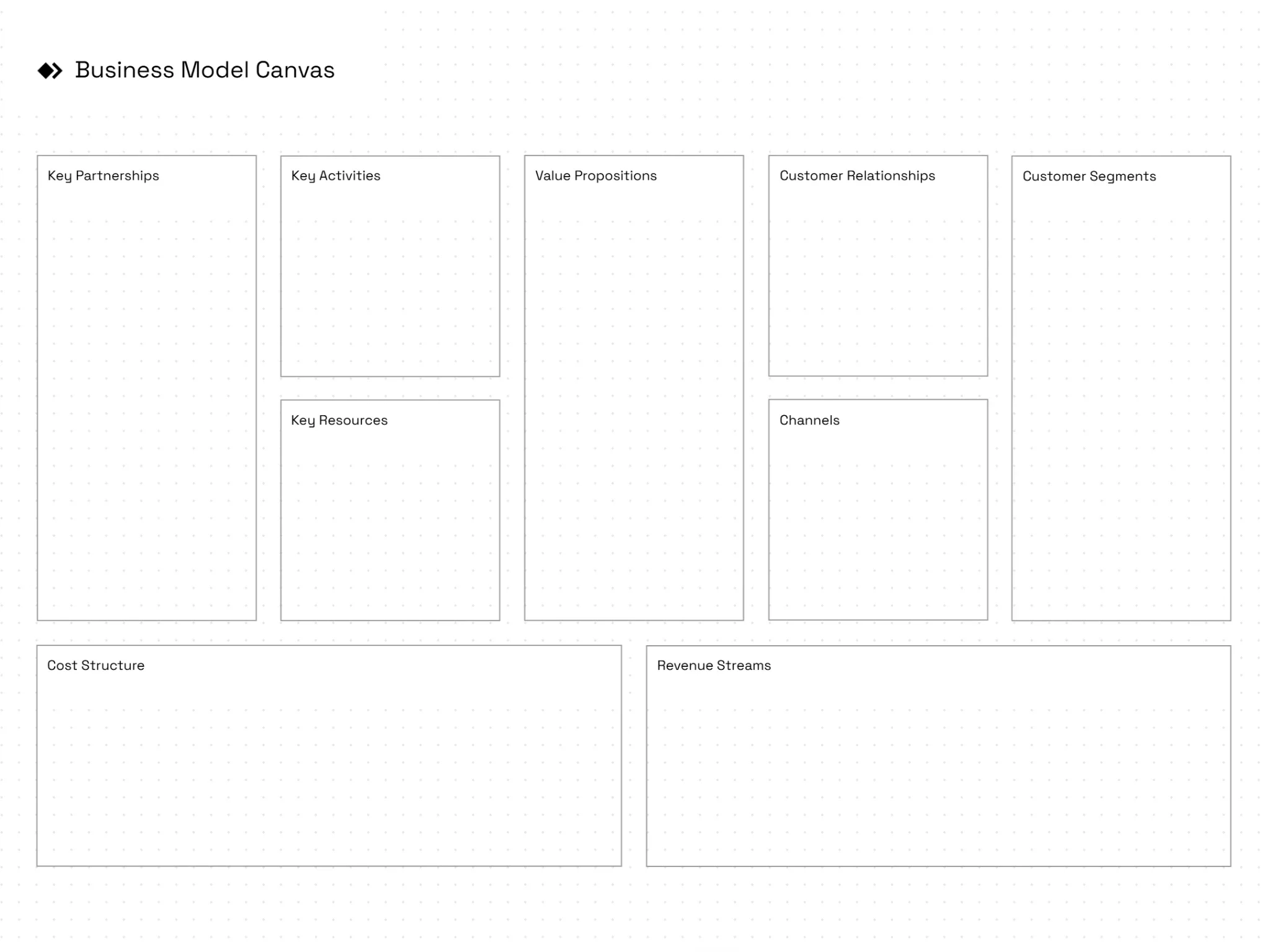
The Business Model Canvas describes how a business creates, delivers, and captures value on a single page. Its nine building blocks are Customer Segments, Value Propositions, Channels, Customer Relationships, Revenue Streams, Key Resources, Key Activities, Key Partnerships, and Cost Structure. Developed by Alexander Osterwalder and Yves Pigneur, it is among the most widely used tools in innovation and strategy.
The layout places the customer-facing side on the right and the operational side on the left, with the value proposition in the center connecting them.
Use it to document an existing business model, design a new venture, compare competitors' models, or test how a trend or scenario could disrupt current ways of making money. It is especially useful in innovation and strategy workflows where people from different functions need a shared picture of the business.
Teams choose it because it turns an abstract concept into something concrete and discussable. It exposes assumptions, shows how changes in one block affect others, and makes it easy to sketch and compare alternative models. Paired with foresight, it helps teams ask how their business model would need to change to succeed in a different future.