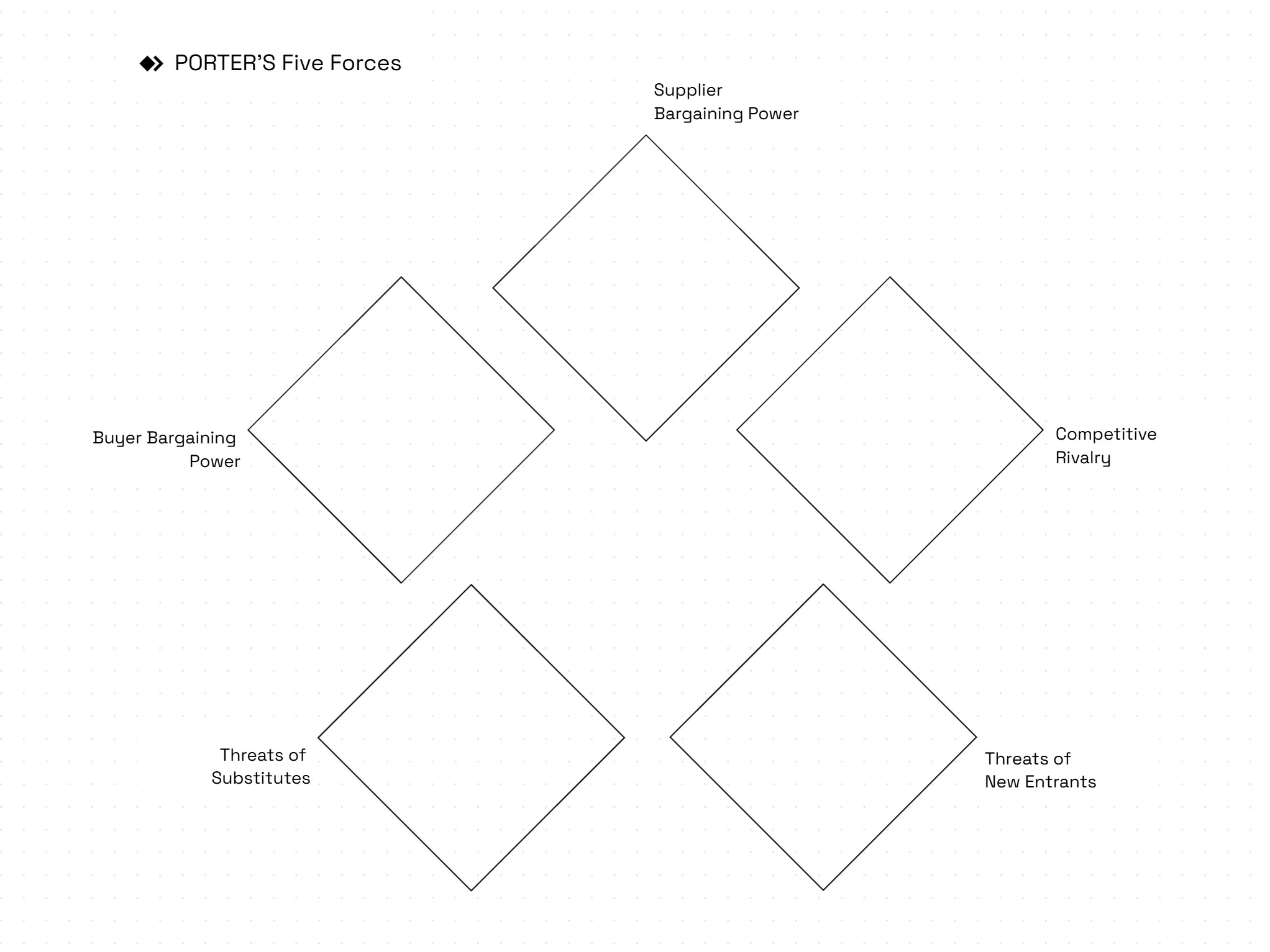
Porter's Five Forces assesses the attractiveness and profitability of an industry by examining five competitive pressures: rivalry among existing competitors, the threat of new entrants, the threat of substitute products or services, the bargaining power of buyers, and the bargaining power of suppliers. Developed by Michael Porter at Harvard Business School in 1979, it remains a cornerstone of competitive strategy.
Each force is rated by its strength, with supporting evidence. Strong forces squeeze margins; weak forces leave room for profit. Together they explain why some industries are consistently more profitable than others.
Use it when evaluating entry into a new market, assessing an acquisition target, reviewing the competitive dynamics of an existing category, or explaining margin pressure to leadership. It is most useful at the industry or segment level rather than for a single company.
Teams use it because it looks beyond direct competitors to the full set of forces that shape value capture. It highlights where power sits in a value chain, where disruption may come from, and which strategic moves, such as differentiation or supplier diversification, could strengthen the business's position.