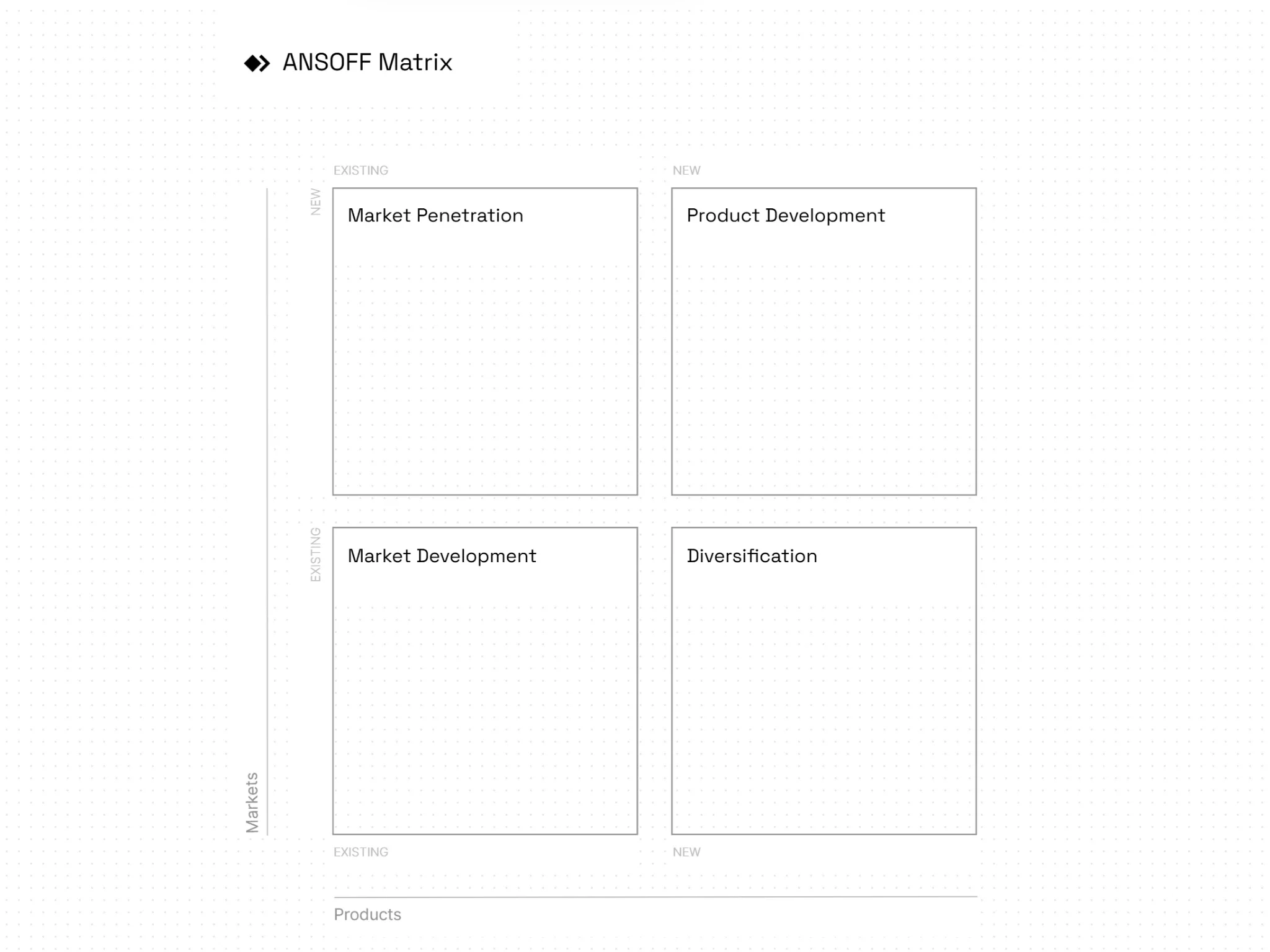
The Ansoff Matrix maps growth options along two dimensions: products, existing or new, and markets, existing or new. The four resulting strategies are Market Penetration, selling more of existing products in existing markets; Market Development, taking existing products to new markets; Product Development, creating new products for existing markets; and Diversification, new products in new markets.
Developed by Igor Ansoff in 1957, it remains a standard tool for structuring growth strategy. The quadrants carry increasing risk as a business moves away from what it knows, with diversification the riskiest.
Use it when a leadership team is setting growth priorities, building a business case for expansion, or comparing a list of growth ideas. It helps when there are more opportunities than resources and the team needs a clear way to weigh them.
Teams use it because it makes the risk profile of growth explicit. It prompts them to consider the full range of options rather than defaulting to one, and it pairs well with research: penetration and development choices rely on customer and market insight, while diversification calls for broader scanning and foresight.