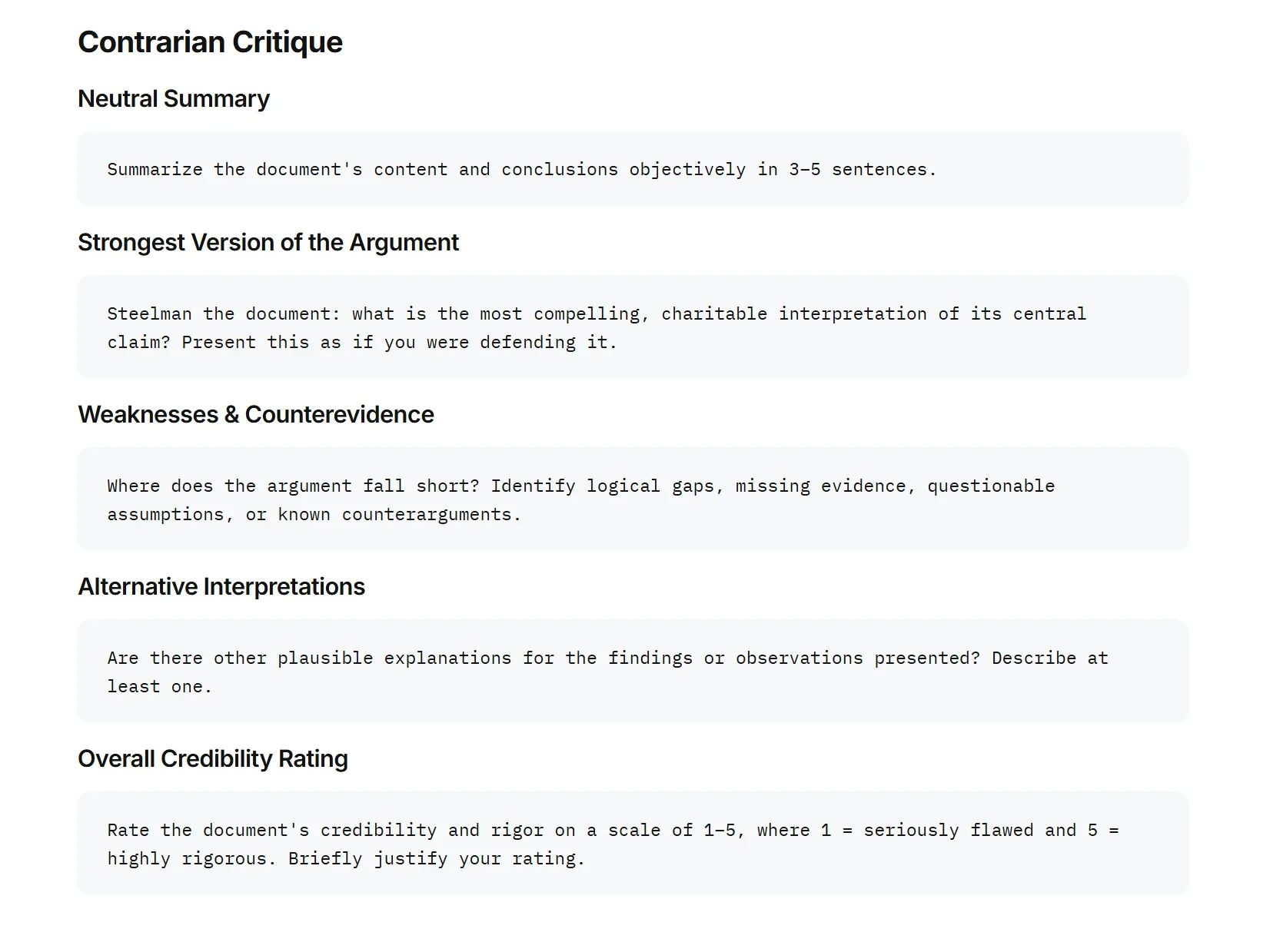
Contrarian Critique puts a document's argument under deliberate pressure. The AI Assistant first summarizes the document neutrally, then builds the strongest, most charitable version of its central claim, and only then critiques it: identifying logical gaps, missing evidence, questionable assumptions, and counterarguments, and offering at least one alternative interpretation of the findings. It closes with a credibility rating from 1 to 5, with a justification.
The sequence matters. Constructing the strongest possible the argument before critiquing it ensures the critique engages with the document at its best rather than a weakened caricature, so the resulting assessment is fair as well as rigorous.
Use it when a document is influential, surprising, or likely to shape an important decision, and the team needs to understand where it could be wrong before relying on it. It is also useful for preparing for challenge from stakeholders and for evaluating vendor or advocacy research.
Teams use it because persuasive documents are not always sound ones. A structured critique counters confirmation bias, surfaces risks that an enthusiastic reading would miss, and gives decision-makers a balanced view of how much confidence a document deserves.