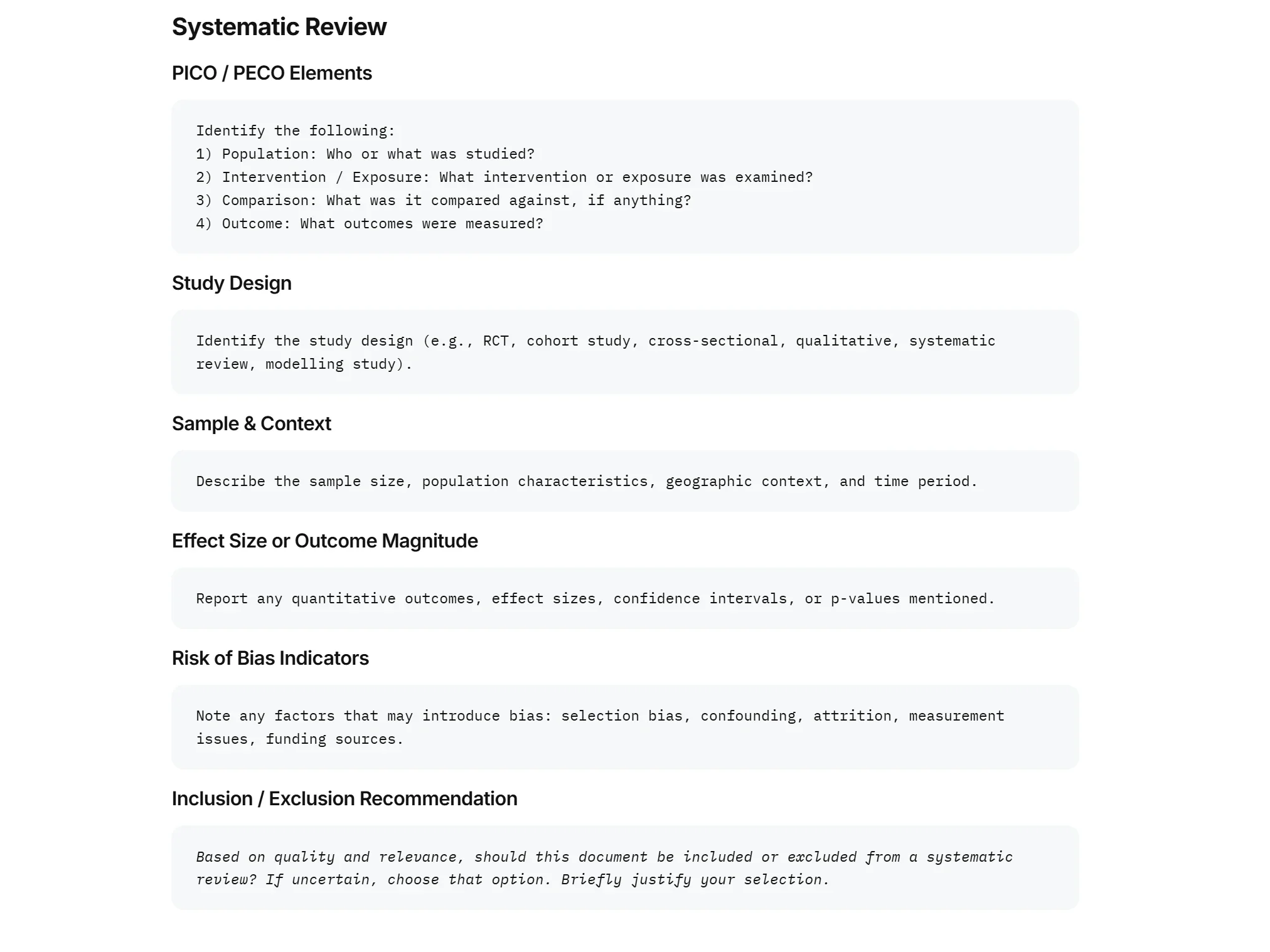
Systematic Review extracts structured data from a study in the form needed for a systematic review or meta-analysis. The AI Assistant records the PICO or PECO elements (Population, Intervention or Exposure, Comparison, and Outcome), the study design, the sample and context, any effect sizes or quantitative outcomes, and indicators of bias such as selection effects, confounding, attrition, or funding sources. It closes with a recommendation to include, exclude, or treat the study as uncertain, with a reason.
The template is deliberately conservative. Where information is missing or unclear, it says so rather than inferring, which protects the integrity of any analysis built on the extracted data.
Use it when a team is reviewing a body of studies against a defined question, such as the effectiveness of an intervention, the evidence behind a health or behavioral claim, or the impact of a policy. It suits rigorous evidence reviews in healthcare, consumer science, public policy, and any field where findings need to be pooled and compared.
Teams use it because systematic reviews demand consistency across dozens or hundreds of sources. A standard extraction format speeds up screening, makes quality judgments transparent and auditable, and gives the team a clean dataset for synthesis and meta-analysis.