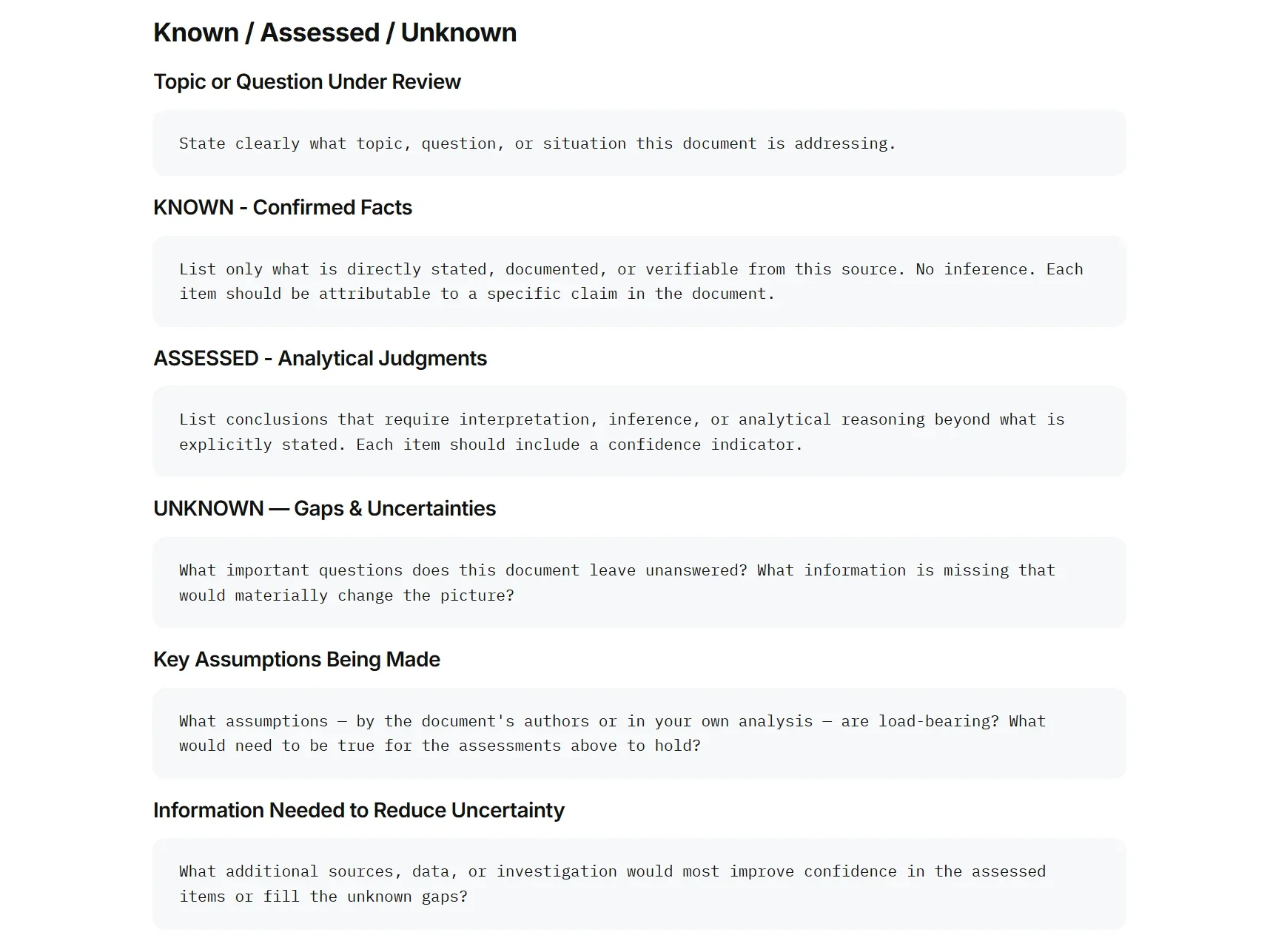
Known / Assessed / Unknown imposes epistemic discipline on a document by sorting its content into three clearly separated categories. Known items are directly stated and verifiable from the source. Assessed items are analytical judgments that require inference, each tagged with a High, Medium, or Low confidence level. Unknown items are the important questions the document leaves unanswered. The template also captures the assumptions the assessment depends on and the information that would most reduce uncertainty.
The approach comes from professional intelligence analysis, where blurring fact and judgment is a common cause of poor decisions. Hedged language such as "likely" or "cannot be determined" is used deliberately to keep the distinction clear.
Use it when a document will inform a high-stakes decision, when sources are partial or ambiguous, or when briefing leaders who need to understand not just what is known but how confident the team is. It is especially useful for competitive intelligence, risk assessment, and fast-moving situations where information is incomplete.
Teams use it because it makes uncertainty visible and manageable. Decision-makers can see exactly which conclusions are solid and which are judgment calls, and the list of unknowns turns directly into a plan for further research.